A plaintiff PI demand letter is rarely just a legal argument. It is often built from treatment records, billing ledgers, imaging reports, wage documentation, adjuster correspondence, photos, and attorney work product. That is exactly why HIPAA questions come up quickly when a firm considers using AI in the demand workflow.
The right question is not whether AI can help organize a demand package. It can. The better question is whether the tool, vendor relationship, and firm workflow are designed for the kind of protected health information and confidential case strategy that plaintiff attorneys handle every week.
Why HIPAA becomes a demand-letter issue
For PI firms, HIPAA is not an abstract healthcare compliance topic. Demand letters routinely rely on medical narratives: emergency department records, orthopedic notes, physical therapy timelines, pain-management recommendations, diagnostic imaging, future-care discussions, and billing summaries. Even a modest soft-tissue case can include dozens of pages of records and itemized charges. A surgical case, disputed causation file, or treatment-gap issue can involve hundreds of pages.
That information is not merely background material. It is the factual basis for the demand. The attorney has to decide what matters, what should be emphasized, what should be left out, and how the medical story connects to liability and damages. AI tools can assist with summarization, chronology building, and first-draft organization, but the inputs may include protected health information, confidential communications, and attorney work product.
That is why consumer-grade AI accounts are usually the wrong fit for a PI demand workflow. If a staff member copies a client’s medical narrative into a general-purpose chatbot without an approved vendor relationship, retention policy, and security review, the firm may create problems that are completely separate from the quality of the draft. The issue is not just whether the output reads well. The issue is whether the firm can defend how the information was handled.
The vendor questions PI firms should ask before using AI
A plaintiff firm does not need every attorney to become a healthcare compliance officer. But someone inside the firm should be able to answer a few practical questions before medical records are uploaded into any AI system.
1. Is there a business associate agreement when PHI is involved?
If a technology vendor receives, stores, processes, or transmits protected health information on behalf of a covered entity or business associate, the relationship may require a business associate agreement. PI firms should not treat that question casually just because the tool uses the phrase “AI.” The safer operational posture is to ask directly: does the vendor support HIPAA-eligible processing, and are the underlying model providers covered by appropriate agreements where needed?
For legal teams, the practical takeaway is simple. Do not evaluate an AI demand-letter platform only by the sample output. Review the vendor’s security posture, data-processing terms, retention practices, and whether the vendor can support the kind of medical-record workflow your firm actually runs.
2. What happens to uploaded records after processing?
Retention matters. A demand-letter workflow may include records that contain sensitive treatment details, billing data, insurance information, and internal case notes. The firm should know whether uploaded files are stored, for how long, who can access them, whether they are used to train models, and whether deletion controls exist.
For many firms, this is where “free” or generic AI tools become expensive in risk terms. A low-friction upload box is not enough. If the vendor cannot explain how records are handled after upload, the firm should slow down before using it for real case material.
3. Can the firm preserve attorney review and work-product control?
AI-generated summaries and demand drafts should be treated as attorney-review materials, not final legal work. The attorney remains responsible for accuracy, omission risk, tone, legal framing, and compliance with professional obligations. That is especially important in PI demands, where a summary that looks polished can still miss a prior injury, treatment gap, lien issue, causation dispute, or policy-limit fact.
Work product also matters. A demand letter is not only a compilation of medical facts. It reflects case valuation, negotiation posture, liability theory, and strategic choices about what to emphasize. Firms should use AI in a way that supports that attorney judgment rather than outsourcing it.
Where AI can help without weakening compliance discipline
Used correctly, AI can reduce the manual drag in the demand process while keeping the attorney in control. The best use cases tend to be structured, reviewable, and tied to discrete tasks rather than broad “write my demand” prompts.
- Chronology extraction: turning scattered treatment records into a date-ordered medical timeline for attorney review.
- Record issue spotting: flagging treatment gaps, missing bills, causation notes, prior-condition references, or unclear diagnoses that need human attention.
- Draft organization: assembling liability, treatment, damages, and demand sections into a coherent first draft.
- Consistency checks: comparing the draft against uploaded records so the attorney can identify unsupported statements before the demand goes out.
Those are not magic tasks. They are workflow tasks. A good AI system makes them faster and easier to review; it does not remove the attorney’s responsibility to verify the record, apply legal judgment, and decide what belongs in the final demand package.
This is also where firms should distinguish between a general AI writing tool and a product built around PI demand-letter work. A tool designed for the PI workflow should understand that medical chronology, damages framing, record support, and attorney review are part of the same chain. For a broader background on how these tools approach demand drafting, see How AI Legal Tools Handle California Demand Letters.
A practical HIPAA-aware workflow for PI demand drafting
Before adopting any AI workflow for demands, a firm can reduce risk by documenting a simple internal protocol. It does not need to be complicated, but it should be real enough that staff know what is allowed.
- Classify the material before upload. Separate public documents, ordinary correspondence, medical records, billing records, and attorney strategy notes. Treat medical and client-specific documents as sensitive by default.
- Use only approved tools for case material. Do not let staff experiment with client records in personal AI accounts or browser extensions that have not been reviewed.
- Confirm vendor terms before production use. Look for HIPAA-eligible infrastructure, BAAs where appropriate, retention controls, and clear statements about model training.
- Keep attorney review mandatory. Require a human review of medical facts, causation language, demand amount, exhibits, liens, and any legal position before sending.
- Audit early drafts. For the first several matters, compare AI-assisted summaries against the source records to learn where the tool is strong and where the firm needs checklists.
That last step is underrated. Attorneys often discover that AI is useful, but only after they define the review standard. A chronology may be directionally right but miss a disputed treatment gap. A damages section may be organized but too conclusory. A liability section may need more connection to the facts. The workflow improves when the firm treats AI output as a draft layer inside the existing demand-review process.
How Legal Power AI fits
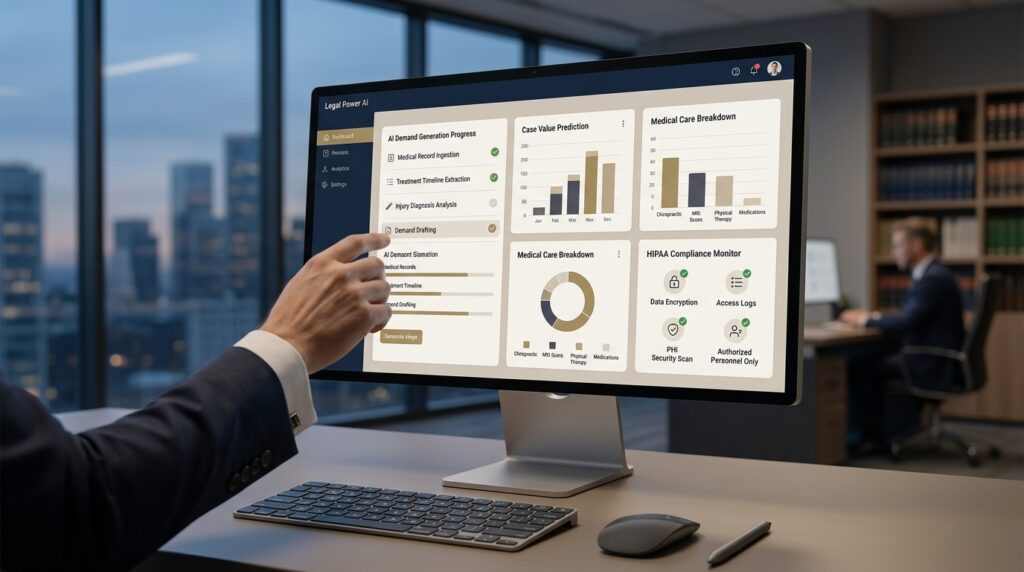
Legal Power AI is built for plaintiff PI demand-letter workflows, with the expectation that firms are working with medical records, damages analysis, and attorney work product—not generic marketing copy. The product is designed to help organize records and draft demand materials faster while keeping attorney review, accuracy checks, and firm judgment at the center of the process.
The bottom line for plaintiff PI firms
AI can be a serious advantage in demand preparation, but only if the firm treats compliance as part of the workflow instead of an afterthought. HIPAA, confidentiality, vendor terms, and attorney review are not obstacles to using AI. They are the guardrails that make AI usable in real PI practice.
The firms that handle this well will not be the ones that chase every new tool. They will be the ones that choose purpose-built systems, document their internal rules, and keep lawyers responsible for the final work product.
Want to see a HIPAA-aware demand workflow built for plaintiff PI firms?
Legal Power AI handles demand-letter drafting inside a review-first workflow, so attorneys can move faster without giving up control of the case.